SWG Mini-Mekons S1 E1
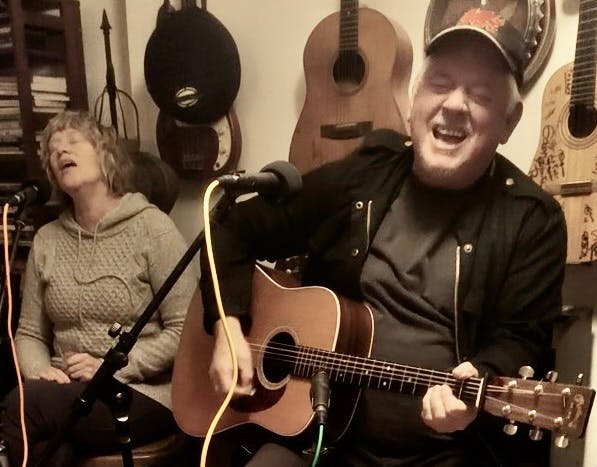
The Mini-Mekons – a scaled down version of 70s UK musical art collective The Mekons is lead by Jon Langford & Sally Timms. They join me in an apartment in New York City for a fun conversation and three exclusive performances.
Transcript
Gianluca
Welcome to the Sitting with Gianluca season opener, after years of being a syndicated radio show are now officially in podcast land. My opening guests are the Mini-Mekons, a scaled down version of UK’s mid-70s arts collective the Mekons, led by singers John Langford and Sally Timms. Both now live in Chicago and also have their own projects. Songwriter John Langford is also part of several groups including the Waco Brothers, Skull Orchard, Pine Valley Cosmonauts and a whole host of other bands. So sit with us for some fun conversation and exclusive live music and please if you can hit subscribe and most of all, thank you.
Gianluca
All right, that was Western designed by The Mekons. I have two of them here plus plus some side musicians. Yeah, John Langford Sally Tims the second I would have to say the second longest running musical partnership I think in 20th 20th century vernacular music
Jon
Is that right with who I think the longest running musical partnership?
Gianluca
Might be Jorma Kaukonen and Jack Cassidy from hot tuna and Jefferson airplane But you have sort of been playing and singing together for, what, 40 years?
Jon
We invited Sally to sing on The Mekon Story, which was a fake retrospective album. It was presented as a retrospective, but it was actually, most of the songs were recorded freshly for it in someone’s bedroom. And Sally came and sang a song called Byron, which wasn’t about Lord Byron. So that was 1982.
Sally
Okay. What about Roger Troutman? I sang that too.
Sally
Catford, was it? That was a real hit, as you can tell. An incredible, I can’t remember it.
Sally
That’s the kind of thing we used to do in the 80s.
Jon
Honestly, whatever it did, we would sing along to it.
Gianluca
I would have to say that is a genuine toe tapper it was not
Jon
It’s available on The Mekon Story, you can find it on Yes! All great streaming devices if you want to buy weapons in space, you can download it.
Gianluca
Of course that kind of useless fact number 372 actually according to Jan Luca here Phil Ochs did Phil Ochs his greatest hits that had all new stuff on it so you kind of oh so wait 82 I can’t do the maths but that’s an awful long time
Sally
44 years. Is that right? 43 years of rubbish
Gianluca
That’s bad. 43 years.
Sally
of rubbish.
Jon
Hahahaha
Gianluca
And don’t you forget it. And don’t you forget it. No, Bobo. We’ve had some hype.
Jon
You have some low points and everything and it’s everything quite a lot in between
Sally
It runs the gamut
Gianluca
No, because I was thinking, right? What is a gamut? What is a gamut?
Sally
It’s like a steak made of fish. Oh, that sounds really good. Can I get the gamut and pineapple? It’s like a gamut and halibut mixed together.
Jon
Just for the hell of it.
Gianluca
I think that’s called the haggis. I don’t know.
But are both of you from musical families? Well Wales is known for singing. That would be Mr. Langford over there. Well Yorkshire, right, is also known. There’s a lot of music in Yorkshire. There wasn’t any…
Sally
My family no no one in my family was particularly musical my parents weren’t but they liked music my dad always was whenever anything kind of bass Latin based would come on he would get up and start dancing but no they liked music but no one was a musician
Jon
He played trumpet when he was a kid because they used to have musical evenings, but he only told me about this much later in life, I never knew anything, because they didn’t have TV or stuff like that when he was a kid, so they used to have these musical evenings where people would bring musical instruments and they would play them and he would play the trumpet and he couldn’t play it very well, but I’d love to be at one of those. That was the entertainment.
A lot of people are going to bring some musical instruments around it.
Sally
No, the reason we are still musicians and became musicians is purely because of punk. I mean, I sang in this church choir and I…
Jon
in a Welsh client.
Sally
I met Pete Shelley when I was 18 and I told him and I told him about this Imaginary operatic language that me and my friend had come up with was stoned and he said let’s go and record it And we went and recorded a completely improvised little mini Electro rock opera the next day and that came out as a record it exists called hangahar and then I started hanging out in Leeds with all this lot after that and Everyone was in a band and it didn’t matter where you
Jon
people, the people who didn’t.
Sally
I know you were in the minority if you weren’t in a band so everyone just started playing music
Jon
It was licensed, punk gave you license to be in a band where the 70s, it was just, you know, virtuosity was everything and the prog rock thing, you had to be playing million notes a minute and suddenly there was this, we misunderstood I think what punk rock was because in London I think it was more or less a continuation of the pop industry and the fashion industry but the kind of manifesto was so persuasive that we heard the sort of smoke signals, saw the smoke signals up north and we thought it was this license to do whatever you wanted and to control, like people started setting up their own labels, forming bands when they couldn’t play, setting up their own clubs which were kind of very political like a rock against racism club and stuff like that. Yeah it was a free-for-all.
Sally
Everyone could do it, and they did, actually. It was a very odd time looking back on it, because it was not, I would say, it was a community movement, but it wasn’t particularly friendly. It was, my memories of it wasn’t friendly at all. It was all in black and white. Yeah, it wasn’t like a bunch of people going, let’s do this really positive thing.
In a lot of ways, it was quite aggressive, and there was a lot of violence around punk. I mean, I didn’t really experience it, because I was just not part of that, but they did. When are the late 70s? Yeah, yeah. A lot of violence around the gigs. There was a lot of right-wing sort of street action. A lot of stuff going on that made it really edgy, and I think at the time, obviously, in England, especially in the north, it was grim.
Jon
When a class did white riot, all the kids in the leads thought that meant… It was like a fascist anthem, you know? And it was the exact opposite.
It was pledging solidarity to the West Indian kids in the not-in-ill riots and saying, look at them, we should have a riot as well. The white kids should have a riot and get political. But by the time it had gone up the M1 200 miles, it was a fascist anthem, which teaches you some lessons about how you can… You have to be a bit responsible when you write songs.
Gianluca
But the irony, of course, is that the Clash organised RockAgainst Racism. Oh, no, they were. No, I’m not doubting anything they did. It was just the way it was all…
Jon
open to misinterpretation.
Jon
But you had Siouxsie Sioux from Siouxsie and the Banshees and Sid Vicious from the Sex Pistols wandering around wearing swastikas, basically to upset the parents who’d won the Second World War. That’s what that was about. It wasn’t about racism, it was just to upset your parents.
Sally
of kind of just boring rebellion against the status quo which was fine I suppose but then there was in the margins there were some really interesting things going on. We were lucky to be in the North.
Jon
because in the North, I think people got it. In Sheffield, everyone bought synthesizers and started making weird synthesizer music. Manchester’s, that scene in Manchester, so many great bands came out of that and they were very, really different.
They weren’t like, they weren’t trying to make a career. They were just like, oh, we can do this. And it was-
Sally
of women making music.
Jon
suddenly women in bands when they really it was a real oddity to have a woman in a band.
Gianluca
Also, and I have to say for people that haven’t lived in Britain, Britain is very, very centralised. Everything is in London, kind of.
If you want to go anyplace, you have to go to London. And so presumably then the North of England sort of didn’t have the self, what’s the word?
Sally
It wasn’t self-referential. Rather like New York and LA, Chicago’s a blue-collar town. It was different.
Jon
Chicago it was it was eerily similar it was like people there were it was a different atmosphere it wasn’t about your career wasn’t it was just like oh well you want to do that all right we could help you do that yeah it’s the same thing in
Sally
the north, the north was different, or smaller towns, not even the north, anything outside of London, radiated out in a different way. It was an interesting time, but I mean, I don’t have a lot of great happy memories about it being this fantastic existence, but people went out and did stuff.
You could make, make things, you know, and that was the liberating factor for me that you could just go, yeah, I didn’t think I would carry on being a musician to me, it was just a big laugh, you know, I didn’t even know. And that was a big downer. It was a big downer. I used to go to watch the Mekong shows and me and my cousin would just be pissing ourselves going, how can they get up on the stage and do this? And then I ended up in it.
Jon
Oops, yeah. It’s a big misstep there, Tims.
Sally
I mean I love those early records but it was kind of pretty messy and chaotic and then by the time I became kind of a more full-on performing member Suzie was already in it, Steve was already in it, Lou was already in it. Dick Taylor was in it.
So the band really transformed at that point into a very different thing. We got back to
Jon
We were on Virgin Records, you know, after the first couple of singles did quite well independently and we stupidly signed the Virgin Records But I suppose it was kind of the right thing to do no regrets But then we split up when they their accountants told us to go away basically The band sort of split but we were all still friends So we used to make we did that meekin story record because we just used to hang out Kept wanting to do things and then when the miners strike up and we wanted to play benefits the three Johns My other band would playing benefits for the striking miners and their families So the Tom wanted to do that with The Mekons.
Let’s get The Mekons back together and we got we’ve got some ringers in some proper musicians
Gianluca
Also the other thing you did I always thought was quite interesting is that in that period country music was so not cool if you were into country music you sort of would be like asked to leave any social event but you were kind of into country music you even recorded Hank Williams songs on the phone
Jon
Yeah, we had did three young Williams songs. Yeah, and there’s a guy called Terry Nelson when we’ve he came over from the states He was from a radio station in Chicago called WZRD, which still going strong In fact me and him went on there recently for their anniversary But you know that was 1980 three and he had all these cassette tapes called honky-tonk classics And I thought I hated country music not knowing that like green green grass of home by Tom Jones is a classic Country song and Johnny.
I love Johnny Cash, but also he was like rockabilly like Elvis or something But that’s country music as well, you know, and we listen to Merle Haggard, George Jones, Patsy Cline, Loretta Lynn and then kind of Everything changed
Gianluca
And you probably didn’t tell a living soul that you listen to those
Jon
People in Chicago people in Chicago thought we were weird. We’d come back from the States in like the late 80s and everyone was into acid house and doing E and listening to sort of pounding techno music and we’d come back with all these records
Sally
In London and in Leeds there were these weird nights that people would have where people would play country dress up in cowboy shirts, shoot little fake capped guns and play country music and we used to start going down there mainly just because it was funny you know it was just strange to see people doing that but that was in London too there were places like that in London but there was a movement of the music scene there was more like a social limit
Jon
movement of like people going yee-haw and having they called it cow punk and we hated that yeah he’s having another conversation
Sally
Yeah, Martin’s mentioning the Lesbian Country Club in Bradford, so yeah, there was just these weird little kind of pockets of people unconnected with music, so eventually all these things kind of strangely came together. We weren’t into making fun of it, we didn’t think it was a joke. No, we liked those things.
Jon
But we weren’t what we wanted to do was treat like Hank Williams and Jimmy Rogers. Yeah seriously like they were I mean to us It was like they were great.
Yeah thinkers and prophets, you know,
Sally
and when you get to the heart of country music it is cool it’s just the exterior kind of gross element of it that is gets very commercialized but you know it goes back to all the things that you love about Americana when you first come here and it’s different and you know people are riding around on a horse in a country country in Western where or having rodeos and like it’s just one of those bizarre things and then you realize there’s all this other stuff going along with it too I just think
Gianluca
I just remember it being very uncool in the 80s. Country music now it’s cool as heck because essentially three-quarters of the truth is punk and after Oh Brother Where Art Thou came out all the false-sleeved tattoos punk rockers sold their electric guitars and that was a kind of…
Sally
Later, too. I think this is early 80s.
Yeah, and then rave culture just took over everything, but that was God awful for the most part there was amazing music as part of that but acid house was just boring Terry Nelson was a
Jon
Did you imagine he said that was The Mekons were like a country western band and then I remember and we were like What do you mean by that? He said cuz all your songs about two chords and they’re all about drinking in bars and failed sexual relationships and it was like and then he played play to some
Gianluca
Oh nice. Oh, I don’t know we’re starting to digress. Do you guys want to play a song?
Jon
A spirited performance by the Mini-Mekons.
Gianluca
That’s off your album and natural and not that you remember because it was a long time ago But we did this before at your drummer Steve Golding’s house many years ago, right?
Yes in the West Village in the West Village You only let me in cuz he thought I was with the BBC I only came to you because I thought you were the meteors
Jon
Is that true? You thought you were The Melvins?
Gianluca
I’m joking. I’m digressing again. But anyway, thank you. But who writes the songs? Sally, do you write at all? In the Mekons? Oh, all at all.
Sally
You do? No, I don’t. Oh go on. I really don’t.
I edit. I’m a good editor. No, that’s part of the writing process. Yeah, I know. But usually the band, it is unusual because we try to basically start when we all get together. And in the last 20 years we got into this idea of having locations where we would go and record things. So that record Natural was made in the Lake District and we just rented a house.
Jon
It was not a recording studio by any means.
Sally
just brought in a brought in a kind of portable recording system and I just remember it being you know this is how we always do it there’s books lying everywhere people are kind of taking lines from books putting things together and making something out of nothing which is a pretty interesting way of doing that that’s always been the case no one’s come up with fully formed songs and said this is my song for the record we start together but you know we all have kind of different roles within the band so that’s so
Jon
actually we only think that’s the only song that we after the initial sessions had any lyrics on it and it was just a guide and then and it was something taken out of I think it was a book about the life story of a football manager and that was a book yeah and then we started just changing them and messing around with them but that that vocal that we did there actually ended up on the album because we couldn’t kind of improve on it.
Gianluca
That was a book lying around.
Jon
the house it was just in that yeah the house we were in so so it was like but sometimes we bring classic story it depends somebody coming home from the war and like you know it was
Sally
There was a friend of ours who had been writing about the Opium Wars, and that became another album, right? That was crucial on Curse of the Mekons, yeah.
And the subject matter of that. So it really depends on, you know, they’re all about…
Jon
Tom’s daughter just said why did you recently she’s been like 16 or 17 she said why do you write all these songs about Cromwell because we’ve got two songs we’ve only got two but it was hard to be human mentions Cromwell and that song Western Design that you played earlier uh it’s about Cromwell as well so we don’t know it’s hard to explain
Gianluca
There’s two rock cliches in the making of natural, right? One is I’m thinking of the Rolling Stones “Exile on Main Street” Cuz you’re sort of sort of in a house
Jon
My head’s back to give a man in the country, that’s what we do.
Gianluca
heads together in the country of course we found a
Jon
stone circle and we all got married.
Sally
We went to a bracken-rigged stone circle and married ourselves in a semi-pagan, made-up ceremony. There’s a video of that, especially in the movie. It’s in the documentary.
Jon
We also went to Wordsworth’s grave while we were there. And we also went to the pub a lot. Yes! And that’s where most of the inspiration came from.
Gianluca
is the ale of inspiration, there is no limits.
Sally
I think after a while we just realized we like to try and make it a fun thing to do. And so, you know, we’ve made a record in the desert, out in California, that was deserted, and then…
Jon
We went to where Tom was living and we rented a house near where he was because he couldn’t travel at the time. We made a record down there.
Sally
We made the last record Horror in Valencia.
Jon
A destination with a beach.
Sally
events that’s what we’re into
Jon
But before that we would record in Chicago and we’d record in London and it’s really hard because people lived there, they couldn’t divorce yourself from everyday life. Everyone turns up late every day.
Sally
if we’re in the same place and all sleeping together in the same one bed, you know, glorious creative juices, marriage, it makes life easier. It’s a nice way of doing things, but we are unusual in the sense of just we don’t really start, we have a concept and then it works from there.
So, you know, that still comes out of punk and maybe out of kind of those situationist ideas that you can make something from scratch very quickly and there are flaws with doing it that way in some ways because the songs generally become better in some ways later after you play them.
Jon
demos then you had to go to a studio and record them. I always liked the demos better and that’s one of your things with you singing you think get the first take because if you don’t even know the song the first take and particularly that one “Dickie Chalkie & Nobby” I just thought one of these songs should have some words on it we’ve just recorded like 12 instrumentals so we just recorded a quick vocal just so it had some structure and then it was like oh well that’s that one that’s done you know and it was no real thought and it just but sometimes the subconscious doesn’t think it does
Sally
anomalies that’s what Lou always said the anomalies are the interesting things and once you once you keep doing it you become wrote so there are songs I’ve sung on albums where I haven’t heard the song more than ten minutes before and I’ve never sung it and there are the lyrics that someone just on a piece and you someone’s and it either works or it doesn’t but often it after about two or three takes it works it’s the best thing because you’re not you you’ve removed yourself from conscious thinking so you have to find it somewhere and then you get these unusual choices that you wouldn’t have made if you knew the song well and as I sing more and more the same song I’ll I’ll become far more normative in the way that I sing it so you lose that so I think it does it does produce interesting ideas at the same time things like tempos and just the band gelling becomes better when we play live I think so there’s two things going on some good some bad so you’ve
Gianluca
called it differently as I presume then the recording process is completely different in that well you’ve probably really answered this different in the country when you’re together as turning up in recordings to also all of your proper
Jon
We were a recording studio in Valencia and we sat in a, it was giant and it was really tall and sounded great and we sat in a big circle and just had little stations with different instruments and people were playing keyboards they didn’t normally play and it was, I don’t know, it was just, and we just sat and played till we felt, thought something was done.
Gianluca
I’m going to maybe build a bridge too far, maybe not far enough. Most of our favourite records, from say the mid-70s and before, are all technically completely wrong.
They’re speeding up halfway through, sometimes they fluff the words, sometimes the mics are too loud, because it was capturing the performance actually.
Jon
Fire by Johnny Cash has got a fantastic tape editing it, because he comes in in the wrong place. So there’s one of the dah dah dah dah dah dah dah dah dah, it doesn’t even finish.
It just goes dah dah dah dah dah, and he starts singing. But they just like chopped it up and left it, you know. I’ll cut that bit out, you know.
Gianluca
Is that one of your favourite songs?
Jon
“Ring of Fire” is a great song. Yeah. Jim Carter wrote that.
Gianluca
So, who amongst, so Sally, you don’t write then? Or, well, no, you edit. You’ve written.
Sally
I’ve written some stuff but very rarely, I’m not really a songwriter, I’m an interpreter.
Gianluca
But John, you write a lot. You write bucket loads, actually. Bucket loads!
Jon
Buckets of **** and Sally filters through it and she finds the one or two songs that may be alright.
Sally
I am a hard critic.
Gianluca
Oh, good. Ah, good. So you write and Sally nips and talks.
Sally
Perhaps. Sometimes.
Jon
Right in in this in the moment it’s suddenly it’s like there’s a moment when you’re you’re in the studio And then you you have ideas you can’t you talk that should this should be about this I mean three of the songs on the new album were written the night before we went in the studio Oh just sitting around because we needed We let’s have some songs that we can kind of like go in and start with and Tom had some ideas I did Tom had an idea of a title He said I like that song drone operator yours.
I went. Yeah, we should have one like that I said, well, what would it be called? He went I think you should be called private defense contractor So I said, how does it go? He went well, I don’t know Haven’t written it. So we just we went we said let’s write it now. So we sat down and wrote it
Gianluca
Alright, and what were the other two songs that you had?
Jon
The other one was Western design and the other one was a war economy.
Gianluca
All right.
Jon
He had the titles and he had bits of lyrics, but no tunes or anything, but we wanted somebody to go in and play something, so we demoed them the night before till about four in the morning.
Gianluca
so how quickly then did you record the album immediately the next
Jon
We were there about eight, nine days.
Sally
how many days eight or nine days we got a lot done often what we started doing which got pretty frustrating is recording most of it but things like then we’d go away and do overdubs and vocals remotely you know we just go and record them then so records would just take forever. The last one took forever
Jon
out to finish it.
Sally
That well, that took forever to mix, but most of it was done. Yeah, I don’t want to do that anymore.
But in the past, we would finish them within a week. So, you know, I mean, these records are not costing a lot of money. The major cost we have now is moving us all around because five of us live in the US and three live in the UK. So that’s an expect eight people and a lot of transportation. It’s a lot of people to move around. So those are the expenses. Studios actually aren’t that expensive. Yeah, if you were in and out faster. Well, and we don’t go to pricey places. The Valencia studio was deranged. It was two hundred and fifty dollars a day.
Jon
It was full of equipment, full of really nice guitars, we didn’t have to take anything. We flew easy jet over there because we didn’t have to take a bag even, it was ridiculous.
Sally
But we still didn’t have to fly from the U.S. So, you know, most of that is it’s a large band, a lot of costs involved in moving everyone around.
Gianluca
Maybe do you guys want to play another song and then, but then we’ll wrap it up.
Sally
The song we’re going to play, actually, interestingly, I did edit very heavily, don’t you remember? I changed a lot of the chord structure. Did you? Yep, you don’t remember that, that’s charming, yep, I did.
I wrote this, this is my song. Yeah, right.
Jon
this with my brain. You’re to blame.
Sally
Yeah, but I did. You played it to me and you had all those weird B-flat things and we took them out and changed it around. You don’t remember any of that.
B-flat? Well, it was some kind of weird… Yeah, it was doing all these odd things and we simplified it and I… You don’t remember this. That’s charming. Of course you don’t. I don’t remember. That was one of my greatest contributions. Really?
Jon
Yeah. It’s nice. It’s a very nice sun. I like the sun. I know, but it’s much better after my input. I don’t remember how it came about at all.
Sally
We sat in your lounge and you played it to me and I said I don’t like where it’s going there change it and you did and it was much better.
Jon
Where do I, where do I, where do they have a land? I don’t know, I don’t.
Sally
have to prove this by law so let’s not worry too much. Clearly you’ve forgotten my input so that’s a very sad story.
No I’m not, we were on Kedzie. Yes you were on Kedzie. I was living on Kedzie and you came over. Is it coming back to you now? We’re lucky we remember you.
Jon
you say you tell me you don’t remember nothing I remember that you don’t know remember nothing I do I remember it anyway this is bickering
Sally
and pointless and will be edited out.
Jon
I’m totally agreeing with you, probably that’s exactly what happened, I just can’t remember.
Sally
Interestingly can’t remember it because it was me getting involved in the in the process and improving what was going on
Gianluca
So, so it goes, it goes like…
Sally
That’s how it went when you first wrote it
Gianluca
oh i like that i want to hear that yeah why did you change it with
Jon
It might have been a hit if you hadn’t changed it.
Gianluca
definite toe-tapper, definitely double platinum, so.
Sally
Maybe it shouldn’t, I’m so trying.
Gianluca
No, but wait, wait, wait. I have a question.
Nip, nip, nip, nip, nip, nip, nip, nip, nip, nip, nip, nip, nip, nip, nip, nip, nip, nip. I like it. I like it. I think that’s a hit. I think that’s a hit. So it was cool.
Jon
Knipping up my knee as well.
Gianluca
So I have a very serious question about this upcoming song. Whose fault is this? This song that you’re about to play? Whose fault is it? Sally wrote it.
Jon
Sally wrote it. If you do like it, I wrote it.
Sally
your audience can decide in the singular.
Gianluca
So it’s either John’s fault, Sally’s fault, or you share the blame. You share the blame? We share the blame. All right. John Rowan.
Sally
So absolutely most of it, but my improvements were monumental.
Gianluca
Yeah, I’m all over it.
Sally
Yeah, wait till you hear it. I can’t, I can’t wait. Sounds like a…
Gianluca
Dancin’, da-da-da-dee
Sally
We’ll be able to use that because that’s Disney killer.
Jon
Yeah, they won’t kill us.
Gianluca
I’m not going to tell anybody, secret’s safe with me.
Jon
“Bing Crosby” and “Walt Disney”.
Gianluca
Well, they’re both six feet under.
Jon
Bing sings and Walt Disney.
Gianluca
Oh, let’s do this song oh yeah, yeah, yeah, let’s
Sally
let the audience decide.
Gianluca
Then as it will never decide who’s fault this is okay
Jon
We’re all about blame.
Sally
Yeah, there’s a lot of shaming and blaming.
Sally
all right well this is that’s the end of the music I think the guitar is voted I think so well you know
Gianluca
It’s rubbish! It’s the guitar’s fault. It’s 100% the guitar’s fault. You can’t get more rock and roll than that, breaking guitar strings.
Did it sound like a gunshot going off? It is, yeah, yeah, yeah, yeah. It’s totally rock and roll.
Jon
It was very effective.
Gianluca
You are listening to Sitting with Gianluca here at sittingwith.com. I’m Gianluca. I’ll be sitting with you for a little bit longer.
Sitting with me is John Langford, Sally Timms from the Mekons, Mini Mekons, various other bands in John’s case. Oh John Pymans, he’s back.
Sally
Simonsky
Gianluca
You can’t say so man. I can’t you not say some asking and here he is and Martin blues hammer cuz I can’t see that Blues
Jon
a harmonica champion in 1986-87.
Gianluca
Martin Smith from…
Jon
He’s of the Charles Bronson School of harmonica playing
Gianluca
absolute and it’s brilliant.
Jon
seen once upon a time in the West. It’s Martin’s the heir to that. How is a very uncorrupted harmonica playing? Yeah.
Sally
uncorrupted by skill or talent.
Jon
Oh, musical taste. That would be me, actually.
Gianluca
Not very
Sally
Very enthusiastic and prepared to do some wonderful dancing.
Gianluca
uh but so i’m gonna drill down a little bit into songwriting when did you take it seriously when did you because you
Jon
written a lot. I think it was with the first when the Mekon suddenly came sort of got fired by Virgin Records and we could just do whatever we wanted and it didn’t matter we just wrote kind of crazy things and we made up songs we just and it was just very free and you know because we didn’t think anyone was listening so we didn’t think we’re being judged so we could just make up mad stuff you know a lot of the best songs came out of that period I think the songs that ended up on fear and whiskey we didn’t think we were even gonna make another record but Tom wrote us I remember we wrote together we wrote “Last Dance” a little eight-track studio in Bridlington song called there’s no country here Tom wrote a song called he beat up his boyfriend which was about his people who lived upstairs from him it was you know it was just I don’t know we just it was very free and we didn’t feel like we we didn’t we had didn’t have an audience so we didn’t feel like we were writing for anyone other than our own amusement that was
Gianluca
Yes, I’m gonna bring it a bit forwards But I have I have a different sort of questions and then I’m gonna come back to songwriting cuz also you have a bunch of different bands Well, Waco Brothers. Yeah Pine Valley Cosmonauts.
I mean what’s all what there’s about five or five bands the Gwent the the Gwent Men of Gwent men of Gwent. Yes Pine Valley Cosmonauts Waco Brothers
Jon
We had the band called the Four Lost Souls with Tony and Beth, me and John, which we had recorded an album in Muscle Shoals. Then we had a band with me and John and Alice and Tammany, and we recorded an album in Austin. But it’s just groups of people coming together for a single project, basically.
Gianluca
So, I don’t have to worry about your split personalities or anything. How do…
Jon
collaborating with people. It’s nice to work with people, you know.
Gianluca
Yeah, yeah, no, that’s what I’m sort of curious about because does each one some of the songs you’ve done with different variations but What is the your philosophy? I don’t think philosophy is a bit of a heavy word But I’m gonna use it because I can’t think of a better word philosophy Yeah philosophy first of all, it’s three syllables.
It’s four syllables. So I like yeah But but why so how do you think of the different bands if do you write the song and then think of a of a band? Now
Jon
He really just writes things for specific projects. Occasionally things come up.
I mean, when I did the first, I did a solo album called Skull Orchard. Because I had a bunch of songs. Another one of the bands, yes. Well, I had a bunch of songs and it was a solo project because all the songs were about basically about South Wales and weren’t much growing up. They were all about gardening there. I was a keen gardener in South Wales during the early 70s and it seemed like a rich vein of material. Now, but I just think there was no way to put them. I couldn’t bring these songs to the mecons. But I was like quite isolated. I was living in the States on my own. And it was interesting that all the songs I wrote, because I was in the States far away from nearly everybody else I’ve worked with. I either wrote kind of raucous, kind of anti-American country songs for the Waco brothers, or I wrote these kind of weird nostalgic folk songs about South Wales for my own purposes. So I had to make, I liked them. So I had to make a solo. I didn’t want to do that, but it’s very thankless.
Gianluca
So, so do you, do you not think too much about songwriting? I mean, some of your songs are kind of, I hate to say this, like real songs.
I mean, I’m thinking like, maybe something like Lost in America, one of this sort of a service.
Jon
to write that song. Oh really? Alright.
Ira Glass asked me to write that song and he gave me the title and I should have made it a much simpler song but I went away and wrote that. It’s an epic, it’s my Bohemian Rhapsody. It is definitely a Bohemian Rhapsody. The entire history of post-civil war America in two and a half minutes.
Gianluca
Absolutely, yeah. But there’s another one I’m thinking about. Well, my favorite song right now this minute, but this will change. I’m very curious about Tom Jones’ levitation.
Jon
It’s a song about the Abavan disaster, basically.
Gianluca
all right you can even have to explain that to anyone eavesdrop on a bird
Jon
Neglect it’s a song about poor governance.
It’s the other van disaster was a thing that happened when I was nine years old and the Yeah Just after my ninth birthday a coal tip collapsed on a village and killed 114 school children after they’d come back to their classroom after assembly and You know, it was they were all kind of my age All around my age and it was about 20 miles from my house And it was quite a formative moment. I would say mm-hmm because it was just the biggest disaster you could imagine and people were you know shocked and and it was under a labor government and The coal board would be nasty for years and years not to put industrial waste in big piles above a village and they didn’t Listen and yeah It was just I mean when I was just very young and it made me think about a lot of things My parents weren’t really really religious, but they were they like to go to church on Sundays And I just just decided well if there’s a God he must be completely perverted Because we could imagine how they died, you know drowning in industrial waste it’s It was just it kind of sort of sorting me out to be a sort of atheist socialist for the rest of my life
Gianluca
Is that one of the songs that you are most proud of? Or what were the songs that you put the pen down? It’s a beautiful song.
Sally
I will give you the points for that one.
Jon
And so on the original regarding Sally actually tells the story about one of the reasons what I wrote It was because there was this opinion poll in the Western male gaming Prince Charles who’s then not now King Charles And they got he got a 26% approval rating from the world’s people for being Prince of Wales And so I made up this bit about well next week They had a poll for who should be the president of a free world’s Republic and everyone votes for Tom Jones and Tom Jones Here’s the news and he flies on but but that’s a necked-off Dylan Thomas the icon fly
Sally
I really love Tell the Dylan Thomas.
Jon
Dylan Thomas in Reminiscence of Childhood, he talks about his childhood in Swansea and it’s just beautifully written.
I love his prose stuff, I mean his poetry is fantastic but it’s like I challenge anyone to understand what he’s on about but when it comes to the prose stuff it’s just really beautiful and he talks about this alley behind the school and he talks about the school and you know just life in Swansea but there’s a bit when you go be in the alley behind the school and the other kids are all bragging like my dad’s got the biggest car in Wales, my dad’s the richest man in Wales and he’s always sad because he hasn’t got a secret, he hasn’t got the brag about the alley of secrets yeah and then there’s a sort of dream sequence at the end or it’s ambiguous as to whether it’s a dream or not but one day he says I went to the alley and I told them I have a secret and they said what is it he said I can fly and he starts flapping his little wings they start tingling and he says he flies up the side of the school up past all the windows of the school like Dracula no Dracula in a school boy cap which I like that line and he flies past the music room window and the music teacher’s teaching someone to play the piano she sees him and she screams and she knocks the metronome off the top of the piano and then there was no more time it’s very cool all right and he floats off across Swansea Bay and he it’s beautiful
Sally
Should we play it?
Jon
that bombshell.
Sally
on that one.
Gianluca
All right. Well, if you have just tuned in you’ve just missed sitting with Gianluca sitting with me has been John Langford Sally Timms from the me cons mini me cons men of Gwent and various of the bands. Langford Overdrive. The Pie Man, John Simanski and the Blues Hammer and Guy. Thank you so much for sitting with me.
This has been wonderful.
Jon
sitting with you. It’s very comfortable sitting on your lap for an hour. Thank you very much.
Gianluca
Yes, my.
Sally
The fire’s gone out, though. Oh, don’t say that. That’s over me.
Jon
How’s it for me, John? You want to talk to me?
Gianluca
You were wonderful. You were wonderful. The fire still burns, John. Thank you, thank you, thank you, thank you. And thank you again. Thank you. All right.